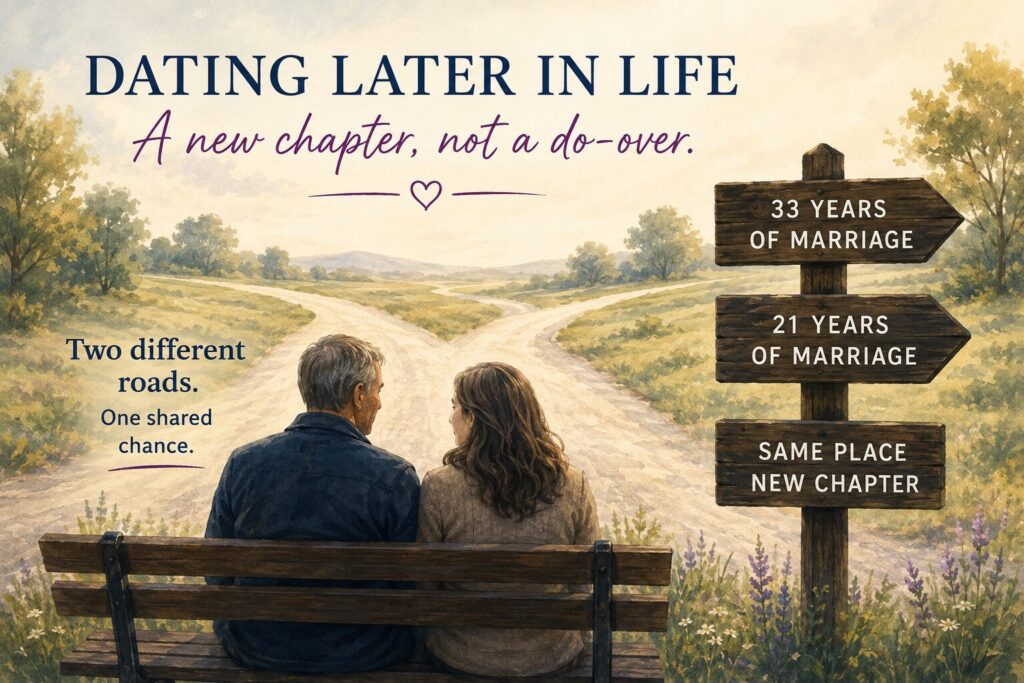
I never imagined I would be dating again in my 50s. Then I never thought I would marry again. Somewhere between those two thoughts, I started dating.
Before I met the man I’m seeing now, I went on what felt like two hundred bad coffee dates, made small talk that went nowhere more times than I can count, and mostly wondered why I was bothering. When I did meet him, I actually tried to keep him in the friend zone for a while, because I honestly wasn’t sure what “ready” was even supposed to feel like at this stage of life.
He had been married for 33 years before his divorce. He has four adult children, and grandchildren already.
His children are a little older than mine. Mine are just now stepping into adulthood themselves, one still in college, one just graduated and starting an internship.
My own story is different. I was married for 21 years before cancer took my husband. I did not choose to end that marriage. I got four years of anticipatory grief instead, four years to make amends, say the hard things, and grieve a little before I actually had to.
Those are two very different roads into the same place. And the longer I’ve dated in my 50s, the more I’ve realized how little the general advice about dating actually accounts for that difference, or for any of the differences that show up once you’ve already built a full life before you meet someone new.
In this article, I want to explore what dating looks like at different stages, in your 20s and 30s, your 50s and 60s, and 65 and beyond. Because it is not the same experience wearing different clothes. It is genuinely a different undertaking at each stage, for reasons that have very little to do with romance and a lot to do with everything else you’re carrying by the time you get there.
The house, the chair, and the life already built
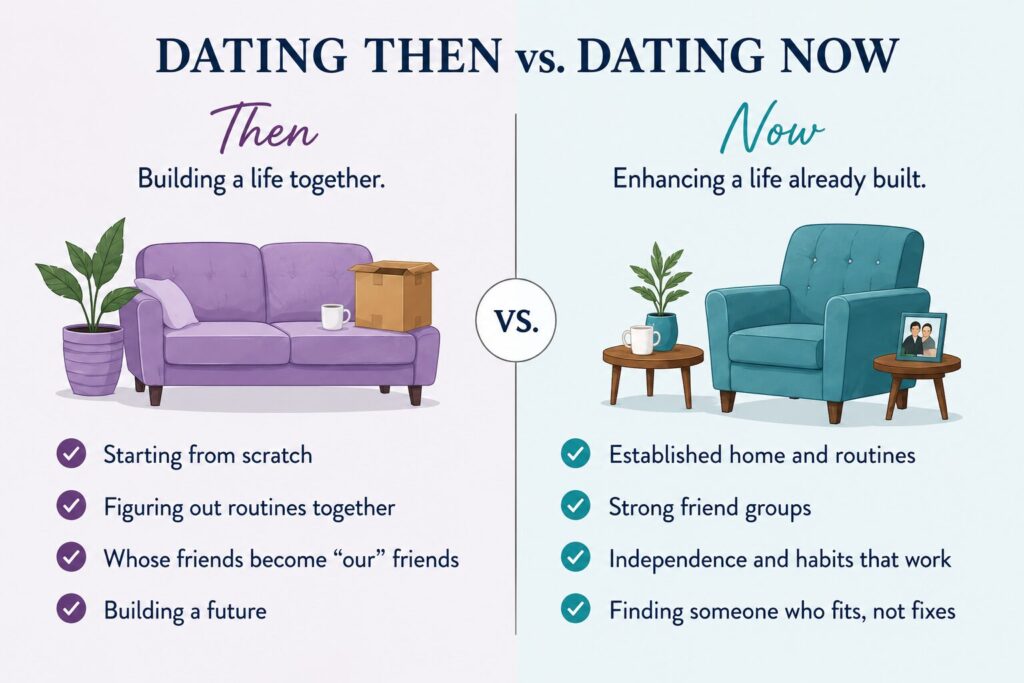
A relationship expert I came across while researching this article put it better than I could: dating in your 50s and 60s is less about building a shared life from scratch and more about finding someone who enhances a life that’s already built. That line stopped me. It is exactly it.
At 25, you and a partner are furnishing an apartment together for the first time, figuring out whose friends become “our” friends, building routines from nothing. At my age, I already have the house. I love it and I am not moving out of it. I have a great friend group I am not looking to replace. I have a rhythm to my week that I like. So does he, in the life he already built after his divorce.
Which means somewhere down the line, if this gets serious enough to talk about merging lives, we’re negotiating whose furniture wins. I say that partly as a joke, mostly not. His favorite chair does not match my style even a little. That is a genuinely funny problem to have at a dinner party. It is also a real conversation about whose life bends and by how much, and neither of us is 25 anymore, willing to bend just because bending is what you do early on.
Add in two different sleep schedules built over decades, two sets of habits that nobody questioned for years because there was no one else in the house to question them, and you start to see why “just move in together” is a much bigger ask later in life than it sounds.
What the research actually says, and why it surprised me
I expected the data to show something fairly predictable: young people dating toward marriage, midlife people slowing down a little, and older adults leaning back toward marriage because of companionship and caregiving needs. That is not what the research shows.
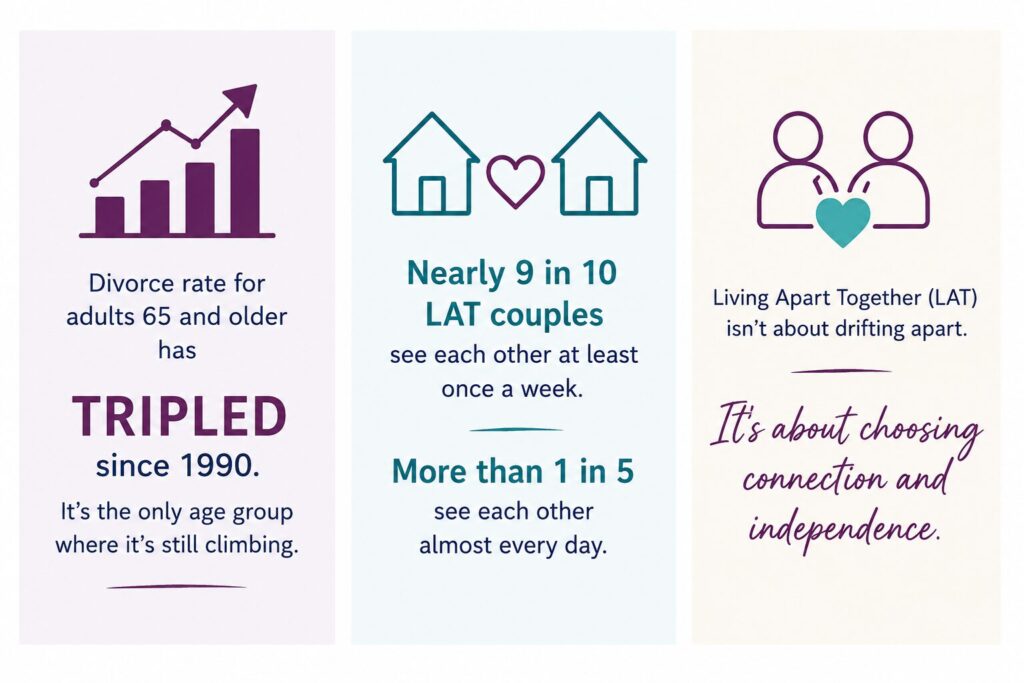
The divorce rate for adults 65 and older has actually tripled since 1990. It is the only age group where it is still climbing. And rather than moving toward marriage as they age, a growing number of older adults are choosing to keep separate homes even in long, committed relationships, a pattern researchers call living apart together, or LAT.
Nearly 9 in 10 LAT couples see each other at least once a week. More than 1 in 5 see each other almost every day. This is not a description of two people drifting apart while maintaining an address for tax purposes. It is genuine partnership, real closeness, real commitment, just without one shared front door.
Here is the part that reframed the whole idea for me. Researchers studying older adults in LAT relationships found the choice is often deliberate, made specifically to protect independence and to avoid an unspoken obligation that tends to come with living together or marrying: the assumption that if one of you gets sick, the other becomes the caregiver, no conversation required. Separate homes let two people build real companionship without either one quietly signing up for a role they never explicitly agreed to.
That reframed my own hesitation for me. It was never that I didn’t want a partner. I have wanted exactly what I have now, someone to be my plus one, someone whose name goes on the concert tickets, someone for weekend plans and date nights. What I have been slower to want is the full merge. Reading the research, I don’t think that makes me unusual for my stage of life. I think it makes me fairly typical of it.
I’ve watched this play out professionally too, not just in the data. In a senior living community I once managed, I watched residents lose a spouse, grieve fully and openly, and then, months or years later, fall in love again with someone down the hall and choose to marry, in their eighties, with a clarity about exactly what they were and weren’t signing up for that I rarely see in people decades younger. It was never naive. If anything, it looked like precisely the kind of deliberate choosing the research above is describing.
Baggage looks different depending on how the last chapter ended
Here is where I want to be honest about something the online dating advice rarely covers well. Divorce and widowhood do not hand you the same starting point, even when the years of marriage were similar.
If your last relationship ended in divorce, you are often bringing forward a co-parent you still see at graduations and holidays, an established pattern of how you two communicate, or don’t, and triggers built from years of a specific kind of conflict. None of that is a flaw in the person. It is just real terrain a new partner eventually has to learn to walk.
If your last relationship ended in death, the terrain is different, not easier, different. There is no ex to navigate holidays around. But there is also no chance to have said one more thing, fixed one more misunderstanding, or simply had more time. I received the unusual gift inside an awful situation: years of knowing it was coming, which gave me space to make peace with things while my husband was still here to hear it. Someone who is divorced, especially someone blindsided by it after three decades, often does not get that same runway. They can be starting to date again while still absorbing the loss of the marriage itself, not just the relationship.
I say this not to rank one kind of loss against the other. They are not comparable, and I don’t think either one is “easier.” I say it because it changes what a new partner is walking into, and understanding that difference has done more for my current relationship than almost anything else I’ve learned.
The role adult children play, and how much it changes by decade
When you are 25 and dating, your parents might have opinions. When you are dating with adult children of your own, the dynamic flips completely, and it surprised me how much research exists on this.
Adult children’s first reaction to a parent dating again is very often not the relief you might expect, even from kids who genuinely want their parent to be happy. Researchers point to a few consistent threads: worry about inheritance, a fear of losing time and attention from a parent they still rely on more than they let on, and something harder to name, a kind of loyalty conflict, especially after a death. Liking a new stepparent can feel, to an adult child, like a quiet betrayal of the parent who is gone.
What the research also shows, and what I think matters most for anyone in my position, is that adult children rarely have the power to stop a parent from moving forward. But they have real influence over whether the relationship succeeds long term. Bringing them in, being transparent about plans, especially around money and the house, is not just kindness. It is what actually protects the relationship.
I’ve sat on the other side of this too, professionally. I’ve worked with adult children trying to manage a blended family’s caregiving decisions once two family histories are involved, where “whose parent, whose call” gets complicated fast. And I’ve watched sons and daughters try to hold together their own marriages or new relationships while carrying the full weight of caring for an aging parent, two real, competing versions of love pulling at the same person at once. None of this is theoretical to me. I’ve sat across the table from it for most of my career.
My situation adds its own texture to this. My partner’s grandchildren are already here and getting older, while mine are still a few years off, if they happen at all. That is not a small difference. It changes what family gatherings look like, what holidays feel like, and what each of us is quietly picturing when we imagine five years from now.
Just dating, versus the weight of forever
Here is the honest center of all of this for me. Dating, even a committed, exclusive, real relationship, feels lighter than marriage. Not because it means less. Because it asks less, at least for now.
We can plan for real, long term companionship, weekends, holidays, being each other’s person, without answering the enormous questions marriage brings up all at once: where do we live, how do finances merge, whose name is on what, what happens to each of our homes. Those are not small logistics. At this stage of life they touch estate plans, retirement accounts, and, yes, adult children’s expectations about inheritance. Thinking about remarriage brings all of it forward at once, and it feels heavier because it is heavier.
Almost everything I want out of a partnership, someone to build a life alongside, someone steady, someone who knows me, is available inside “just dating” the way I’m doing it now. The one piece that genuinely requires marriage or full cohabitation is living under the same roof. Everything else, the companionship, the commitment, the plans, can exist fully without it.
What I’ve learned
Here is what I would tell anyone standing where I’m standing.
Dating in your 20s and 30s is usually about building something from nothing, a shared apartment, a shared friend group, a life that takes shape together. Dating in your 50s and 60s is about two already-complete lives deciding how much of themselves to share, and how much to keep. Dating at 65 and beyond often becomes even more deliberate still, closeness without a shared address, chosen on purpose, not as a compromise.
None of those stages is easier than the others. They are just different problems to solve, and the advice written for one rarely fits another.
If you are dating again later in life, a few things have made the biggest difference for me:
Know whether you are dating someone who chose to leave a marriage or someone the marriage left, through divorce or death. The baggage is real either way, it just shows up differently, and understanding which kind you’re both carrying changes how you show each other patience.
Loop adult children in early and be transparent, especially about money and the house. They cannot stop you from moving forward, but research is clear that their buy-in shapes whether the relationship lasts.
Decide on purpose what “next steps” mean to you, instead of assuming marriage is the only serious option. Dating, living apart together, cohabitation, and marriage are all legitimate destinations, not stages on the way to one correct answer.
And know that wanting a real, committed partnership does not obligate you to merge every part of your life to have it. I said I’d never date again, and here I am. I said I’d never remarry, and what’s true today is that what we have is already enough, at least for now. What I know for certain is that this chapter looks nothing like my first marriage, and nothing like I expected. It has its own shape, its own questions, and its own kind of honesty about what you actually want, once you already know who you are.
References and Resources
Pew Research Center, research on dating, online dating, marriage, and remarriage among older adults
Bowling Green State University, National Center for Family and Marriage Research (NCFMR), family profiles on gray divorce, remarriage, and cohabitation among older adults
University of Melbourne, Pursuit, research summary on living apart together relationships, drawing on the Household, Income and Labour Dynamics in Australia (HILDA) survey
VeryWellMind, commentary from relationship and dating coaches on dating in your 50s and 60s
National Widowers’ Organization, research and commentary on adult children’s reactions to a widowed parent’s remarriage
Kay Pasley and Marilyn Ihinger-Tallman, research on adult children’s influence on parental remarriage outcomes U.S. Census Bureau, American Community Survey data on marriage, divorce, and widowhood among older adults