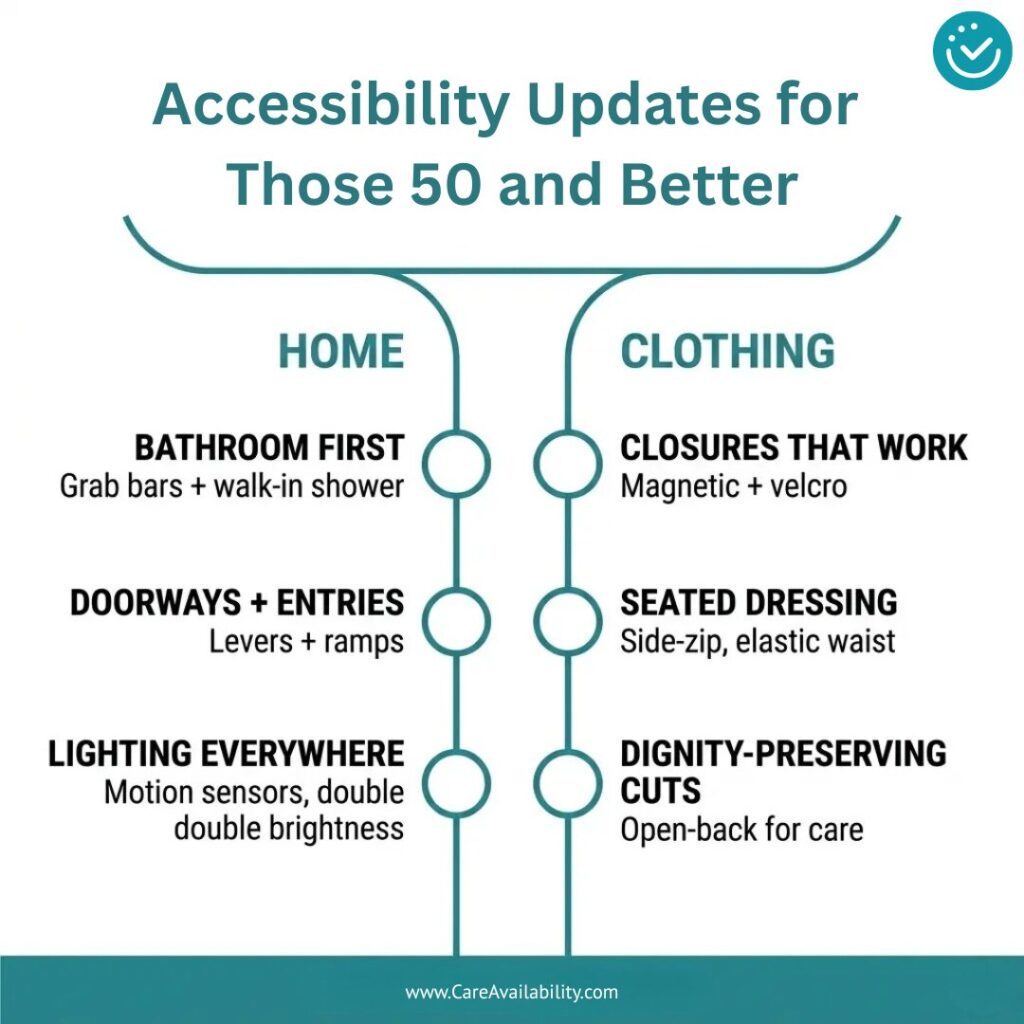
A Practical Guide to Accessibility Updates for Those 50 and Better
A case manager once told a colleague of ours that the most dangerous room in America is the bathroom. She was only half joking. At CareAvailability.com, we have spent years connecting families and those 50 and better with honest, comprehensive care information, and we keep seeing the same pattern: families wait for a fall before they make the changes that would have prevented it.
From our perspective, the goal here is simple. The right resource at the right time changes everything. This guide covers three categories of updates that make daily life safer and more comfortable: home modifications, adaptive clothing, and assistive devices. We also cover how to pay for it, because cost is the question we hear most often. Neither the home updates nor the clothing changes require you to overhaul your life. Most of these changes are small, affordable, and doable this month.
Around 77% of adults over 50 say they want to remain in their homes as they age [1]. The honest truth is that only 1 in 10 U.S. homes currently has the accessibility features to support that [2]. That gap is closeable. Here is how.
Part One: Home Modifications, Room by Room
Start With the Bathroom
Based on our years of experience in this space, here is our point of view: if you only have the budget or energy for one room, make it the bathroom. According to CDC data, about 8 out of 10 bathroom injuries among adults 65 and older happen because of a slip or fall, and roughly a third of those happen around bathtubs and showers.
Here is what to do, in order of impact:
- Install grab bars. Near the toilet, inside the shower, and at the tub entry. When grab bars are installed correctly, fall-related emergency room visits drop by as much as 61% [3]. Mount them into wall studs, and never rely on suction models for weight-bearing use.
- Add a walk-in or roll-in shower. A walk-in shower removes the tub wall, which is where most bathroom falls begin. A roll-in shower has no threshold at all and works for wheelchair users.
- Place a shower seat inside. A sturdy bench lets someone bathe without standing the entire time.
- Switch to a handheld showerhead. It pairs with the seat and gives the person control of the water instead of moving their body toward it.
- Put down non-slip flooring or mats. Textured tile or rubber-backed mats. Remove anything that slides.
Tip: A basic grab bar costs less than a nice dinner out. Research shows people with grab bars are 75% more likely to regain their balance if they slip exiting a bathtub [3]. Few purchases return that much safety for that little money.
Doorways, Entrances, and Getting In and Out
Standard doorways run 24 to 30 inches. A wheelchair or walker often needs 32 to 36. Widening a doorway sounds like a major renovation, and sometimes it is. Sometimes it only takes offset hinges that swing the door clear of the frame and buy you two extra inches. Widening a single doorway typically runs $600 to $2,000 [7].
For the entrance itself:
- Entrance ramps. A modular aluminum ramp installs in a day. Aim for one foot of ramp length per inch of rise, which keeps the slope gentle enough to manage independently. Wheelchair ramps typically cost $395 to $6,000 depending on size and materials [7].
- Lever-style door handles. Round knobs require grip strength and wrist rotation, and arthritis makes both painful. Levers open with a forearm or a closed fist. Swap every knob in the house. This takes one afternoon and a screwdriver.
- Accessible parking. If the person still drives or rides along, keep the closest parking spot clear, well lit, and free of gravel or uneven pavement. Talk to their doctor about a disabled parking permit if walking distance is a struggle.
Stairs: Lifts and Alternatives
One in four Americans 65 and older falls each year, and stairs carry particular risk. There are three options here, and we encourage families to consider all of them honestly.
- Move life to one floor. Free. Convert a main-floor den into a bedroom.
- Install a stair lift. Most straight-rail models run $2,000 to $5,000, with custom curved models reaching $10,000 or more [4].
- Add ramps for shorter rises. A few steps at a landing or garage entry often need only a short ramp.
For context, monthly assisted living costs in many markets reach $10,500. A one-time stair lift purchase starting around $2,500 keeps someone safely at home for years. We say this as an organization that deeply respects senior living communities. When the time for community living comes, it should come because of care needs. A good stair lift buys families time to plan rather than react.
Kitchen, Lighting, and the Whole House
- Lower countertops and cabinets where possible, or add pull-down shelving so nothing essential lives above shoulder height. Lowering cabinets and sinks typically costs $1,500 to $8,500 [7].
- Improve lighting everywhere. Older eyes need roughly twice the light. Add motion-sensor night lights along the path from bedroom to bathroom. This is the single most commonly overlooked modification, and it costs almost nothing.
- Consider smart home technology. Voice assistants, smart thermostats, and doorbell cameras all help. In a 2025 survey, 49% of older adults reported feeling safer using assistive technologies, and 45% felt more independent [5]. Start with one device, learn it together, then add more.
- Auto shut-off timers on stove tops, or front-mounted controls so reaching over hot burners isn’t required.
The national average aging-in-place remodel costs about $9,500. Compare that to annual nursing home costs pegged at over $112,000, and the math speaks for itself. You do not need to do everything at once. Pick the highest-risk area first and work outward.
More Home Modifications
Doorways, hallways, and pathways
- 36″ clearance in doorways and hallways for wheelchairs and walkers
- Removing or securing all throw rugs, or replacing with low-pile, taped-down options
- Transition strips or ramped thresholds anywhere flooring changes height
- Clearing furniture to widen walking paths, not just doorways
Bathroom
- Open or roll-under sinks with knee clearance for wheelchair users
- Toilet risers or comfort-height toilets, plus raised seats with attached grab bars
- Anti-scald or temperature-controlled faucet valves
- Curbless or low-threshold entry even for a standard shower conversion, not just full roll-in builds
Kitchen
- Auto shut-off timers on stove tops, or front-mounted controls so reaching over hot burners isn’t required
- Single-lever faucet handles instead of separate hot/cold knobs
- Under-cabinet task lighting
Stairs and vision
- Handrails on both sides of the stairway, not just one
- Contrast-color strips on stair edges to help with depth perception and low vision
- Non-slip stair treads
Whole-house
- Lowered closet rods
- Raised electrical outlets and lowered light switches so bending and overreaching are both reduced
- Adjustable-height beds
- Medical alert pendants or pull cords in the bathroom and bedroom specifically, since those are the two highest-fall-risk rooms
- Motion-sensor lighting outside at entrances and along the driveway
Part Two: Adaptive Clothing, Dignity You Can Wear
Home modifications get most of the attention. Clothing gets almost none, and we think that is a mistake. Getting dressed is the first thing we do every morning, and when it becomes a 40-minute struggle, it wears on a person’s spirit in a way that is hard to describe unless you have watched it happen.
Adaptive clothing is regular-looking clothing designed for easier dressing. The market has grown significantly because families are discovering it works [6]. Many caregivers still do not know these options exist, so here is a plain rundown.
Closures That Work With Stiff Hands
- Velcro closures that look like buttons. The shirt front shows a normal button placket. Behind it, velcro does the actual work. Nobody at church knows the difference, and that matters to a lot of people [6].
- Magnetic button closures. Magnets snap the shirt closed with a light touch. Ideal for arthritis, tremor, or one-handed dressing after a stroke. Skip these only if the person has a pacemaker, and check with their doctor first [6].
- Pull-up tabs and loops. Sewn into pants, socks, and shoes so fingers can pull instead of pinch [6].
Designs Built for Real Bodies and Real Situations
- Elastic waistbands. Simple and underrated. They remove buttons and zippers from the equation entirely and help anyone with urgency getting to the bathroom [6].
- Side-zip pants. A zipper along the leg lets the pant open flat, which helps with braces, casts, edema, or dressing while seated [6].
- Higher-rise pants for wheelchair users. Standard pants ride down in back when seated all day. Wheelchair-cut pants have a higher back rise and a lower front rise, so they fit properly in the seated position they are actually worn in [6].
- Open-back and open-side garments. These allow a caregiver to dress someone with limited mobility without lifting arms overhead or rolling them repeatedly. From the front, they look like ordinary tops and dresses. For anyone receiving hands-on care, these preserve comfort and dignity for both people involved [6].
- Pull-over tops with wider necklines. No fasteners at all, and the wide neck spares sore shoulders [6].
- Tagless and seamless construction. Thin skin and sensory sensitivity make tags and thick seams genuinely painful. Seamless garments solve a problem most people never think about until they are living it [6].
More Adaptive Clothing
- Front-closure adaptive bras
- Wrap-style or velcro shoes as an alternative to laces entirely
- One-handed zipper pulls on jackets and outerwear
- Adaptive swimwear with easier entry and closures
- Non-slip grip socks
- Adaptive incontinence-friendly underwear that still closes with velcro or magnets
One honest note: some people resist adaptive clothing because early versions looked institutional. Today’s brands, including Joe & Bella, Tommy Hilfiger Adaptive, and Resident Essentials, make pieces with modern cuts, current colors, and fabrics you would find in any department store. Show your loved one the options before assuming they will say no [6].
Part Three: Assistive Devices, the Tools That Bridge the Gap
Between a home modification and an adaptive wardrobe, there is a third category that gets even less attention: handheld assistive devices. These are small, inexpensive tools that extend reach, reduce bending, and preserve independence in the moments between bigger solutions. A grab bar helps at the shower. A reacher helps with everything else.
Reachers and Grabbers
A reacher is a lightweight arm extension, typically 19 to 32 inches long, with a trigger grip and a rubber or magnetic tip. It lets someone pick up a dropped item, pull a shirt off a hanger, retrieve something from a low cabinet, or push a light switch without bending or stretching. For anyone recovering from hip or back surgery, a reacher is often the first tool an occupational therapist recommends because it prevents the exact movement that caused injury in the first place.
Most reachers cost between $10 and $30. Keep one in the bedroom, one in the kitchen, and one near the favorite chair. They tend to disappear when needed most, so having multiples is worth it.
Dressing Sticks
A dressing stick is a dowel-style tool with a hook on one end and a push-point on the other. It helps pull up pants or underwear without bending, push a shirt off the shoulder, and manage socks without reaching down to the floor. For someone with hip restrictions or significant back pain, a dressing stick is what makes independent dressing possible when it would otherwise require a caregiver’s help.
Dressing sticks are often sold as part of a dressing aid kit that also includes a sock aid, a long-handled shoehorn, and an elastic shoelace set. These kits typically run $15 to $30 and are available through medical supply retailers and major online retailers.
Long-Handled Shoehorns
Bending to put on shoes is one of the more dangerous movements for anyone with balance issues, hip replacements, or lower back problems. A long-handled shoehorn, typically 18 to 30 inches, removes the need to bend at all. The person slides the shoehorn into the heel of the shoe, slips their foot in, and stands up. Done.
Pair a long-handled shoehorn with elastic laces or slip-on shoes and the entire shoe routine becomes manageable without sitting on the floor or asking for help.
Other Devices Worth Knowing
- Button hooks. A small wire loop that threads through a buttonhole and pulls the button through. Takes a tricky motion and makes it manageable for arthritic fingers.
- Zipper pulls. A small ring or loop attached to a zipper tab that gives fingers something larger to grip.
- Sock aids. A plastic shell with fabric attached. Drop the sock over the shell, place it near your foot, slide your foot in, and pull the cord to bring the sock up. No bending required.
- Non-slip bathmats and furniture leg grippers. Low-tech but genuinely effective at preventing the small slips that lead to big falls.
- Bed rails and transfer handles. Attach to the bed frame and give someone a stable grip when getting in and out of bed independently.
More Assistive Devices
- Transfer or slide boards, for moving between bed, chair, and wheelchair
- Drop-arm grab bars that attach directly to the toilet
- Bed canes or transfer poles that clamp to the bed frame
- Jar openers and key turners for arthritic hands
- Weighted or built-up handle utensils, and rocker knives for one-handed cutting
- Medication organizers with reminder alarms
- Large-button phones and remotes
- Personal emergency response systems (PERS), wearable pendant or wristband versions
Tip: If you are unsure which devices would help most, ask for a home occupational therapy assessment. Many insurance plans, including Medicare, cover at least one OT visit. An occupational therapist will walk through the home with you, identify the highest-risk moments in the daily routine, and recommend specific tools by name. It is one of the most practical hours you can spend.
Part Four: Paying for It All
Cost is the most common reason families delay accessibility updates, and we understand that. The honest answer is that more financial help exists than most people realize. Here is a clear rundown of what is available.
Federal Grants and Programs
- VA Disability Housing Grants (for veterans). The U.S. Department of Veterans Affairs offers several grants for service members and veterans with qualifying disabilities. The Specially Adapted Housing (SAH) grant offers up to $126,526 for fiscal year 2026. The Special Home Adaptation (SHA) grant offers up to $25,350. The Home Improvements and Structural Alterations (HISA) grant provides up to $6,800 for those with service-related disabilities and up to $2,000 for non-service-related disabilities. If your loved one served, start here [8].
- USDA Rural Housing Repair Loans and Grants. For rural homeowners with household incomes below the “very low income” limit for their county. Grants up to $10,000 are available to homeowners age 62 and older. Loans up to $40,000 are available regardless of age, repaid over 20 years at 1% interest. Grants and loans can be combined [9].
- HUD Home Modification Resources. The U.S. Department of Housing and Urban Development maintains a state-by-state list of housing and homeownership resources. Many states include grants and low-interest programs for home repairs and accessibility updates [7].
State and Local Programs
State and local programs often have fewer restrictions than federal ones. Your state’s housing department, area agency on aging, or local 211 helpline can point you to what is available in your county. A few national resources that can help locate local programs [7]:
- The National Directory of Home Modification and Repair Resources lists programs by state for older adults and people with disabilities.
- The Independent Living Research Utilization program has a directory of organizations that fund assistive technology and home modifications for people who want to remain living independently.
- Rebuilding Together is a national nonprofit whose volunteers make homes safer for low-income families, older adults, and people with disabilities. Qualifications and services vary by location.
Low-Interest Loan Options
- FHA Title I Property Improvement Loan. A fixed-rate loan specifically for projects that improve the “basic livability or utility” of a home, a standard broad enough to include most accessibility upgrades, according to HUD [7].
- FHA 203(k) Rehabilitation Loan. Allows you to buy a home that needs remodeling, or refinance an existing mortgage to include funds for updates. Rates are generally lower than personal loans or credit cards [7].
- Home equity loan or line of credit. If the homeowner has equity built up, this is often the lowest-rate borrowing option available. These loans let you borrow up to 85% of your equity minus what you owe, using the home as collateral [7].
FSA and HSA Funds
Flexible Spending Accounts (FSA) and Health Savings Accounts (HSA) can cover some accessibility-related expenses, though the rules are specific. Here is what generally qualifies [7]:
- Durable medical equipment prescribed by a doctor, including walkers, wheelchairs, grab bars installed for medical necessity, and shower chairs.
- Home modifications deemed medically necessary by a physician, such as a ramp for a wheelchair user or a roll-in shower after a qualifying injury or diagnosis.
- Assistive devices like reachers, dressing sticks, and sock aids may qualify when purchased to support activities of daily living after a major disability.
General home improvements or adaptive clothing purchases typically do not qualify under FSA or HSA rules. The key is medical necessity documentation from a physician. If a doctor recommends a specific modification in writing, keep that documentation when submitting for reimbursement.
Medicare and Medicare Advantage
Original Medicare covers medically necessary durable medical equipment, including wheelchairs, walkers, and hospital beds, but does not cover home renovations. However, some Medicare Advantage plans do cover home accessibility improvements for chronically ill enrollees. If your loved one has Medicare Advantage or is choosing a plan during open enrollment, ask specifically whether home modification benefits are included and what the qualification criteria are. The answer varies significantly by plan and by state [7].
How to Start Without Getting Overwhelmed
Families tell us the same thing every week: “I don’t even know where to begin.” So begin small. Here is a first-month plan that costs under $500:
- Week 1: Install two grab bars in the bathroom and add non-slip mats.
- Week 2: Swap door knobs for lever handles and add motion-sensor night lights.
- Week 3: Order one adaptive clothing item, such as an elastic-waist pant or a magnetic-closure shirt, and let your loved one test it. Add a reacher and a long-handled shoehorn.
- Week 4: Walk the house together and list the next three priorities. Include the person these changes are for. Their buy-in matters more than the hardware.
Be gentle with yourself through this. Change takes time, and you do not have to solve everything before Friday.
Your Next Step
These modifications extend independence, and eventually many families also begin exploring in-home care or community living options. When that conversation comes, you deserve honest information without pressure. Use the resources listed below as your starting point. The right resource at the right time changes everything.
Resources and Citations
[1] PeopleCare. “2024 Aging in Place Statistics.” peoplecare.com/2024-aging-in-place-statistics-a-lucrative-opportunity-for-the-home-care-industry
[2] RubyHome. “Aging in Place Statistics.” rubyhome.com/blog/aging-in-place-stats
[3] YourToiletParts. “What Makes a Good Safety Grab Bar for Elderly Use.” yourtoiletparts.com/blog/what-makes-a-good-safety-grab-bar-for-elderly-use
[4] Warrior Service Company. “Costs of Stair Lifts.” warriorservicecompany.org/costs-of-stair-lifts
[5] All Heart Home Care. “Aging in Place: Elderly Parents and Assistive Technology.” allhearthomecare.com/aging-in-place-elderly-parents
[6] Graying with Grace. “The Ultimate Guide to Adaptive Clothing (Dress Yourself With Ease).” Scott Grant, Certified Senior Advisor. grayingwithgrace.com/adaptive-clothing
[7] NerdWallet. “Home Modification Grants and Loans for Persons with Disabilities.” Annie Millerbernd. nerdwallet.com/home-ownership/home-improvement/learn/accessible-home-modification-grants
[8] U.S. Department of Veterans Affairs. “Disability Housing Grants for Veterans.” va.gov/housing-assistance/disability-housing-grants
[9] U.S. Department of Agriculture, Rural Development. “Single Family Housing Repair Loans and Grants.” rd.usda.gov/programs-services/single-family-housing-programs/single-family-housing-repair-loans-grants
[10] Maryland Department of Disabilities. “Home Modifications.” mdod.maryland.gov/housing/Pages/Home-Modifications.aspx