When Finding Care Means Finding Safety
Seventy-five percent of people over 65 will require long-term care services at some point. That statistic applies to everyone. But for LGBTQ+ seniors, where and how they receive that care carries a weight most families never have to consider. The question is not just “Can they help my mom?” It becomes “Will they respect who she is? Will she feel safe being herself?”
The Hidden Crisis: Going Back Into the Closet
By 2030, over seven million [1] LGBTQ+ adults in the U.S. will be aged 50 or older. This is not a niche population. This is a significant portion of the people searching for care right now.
And many of them are afraid.
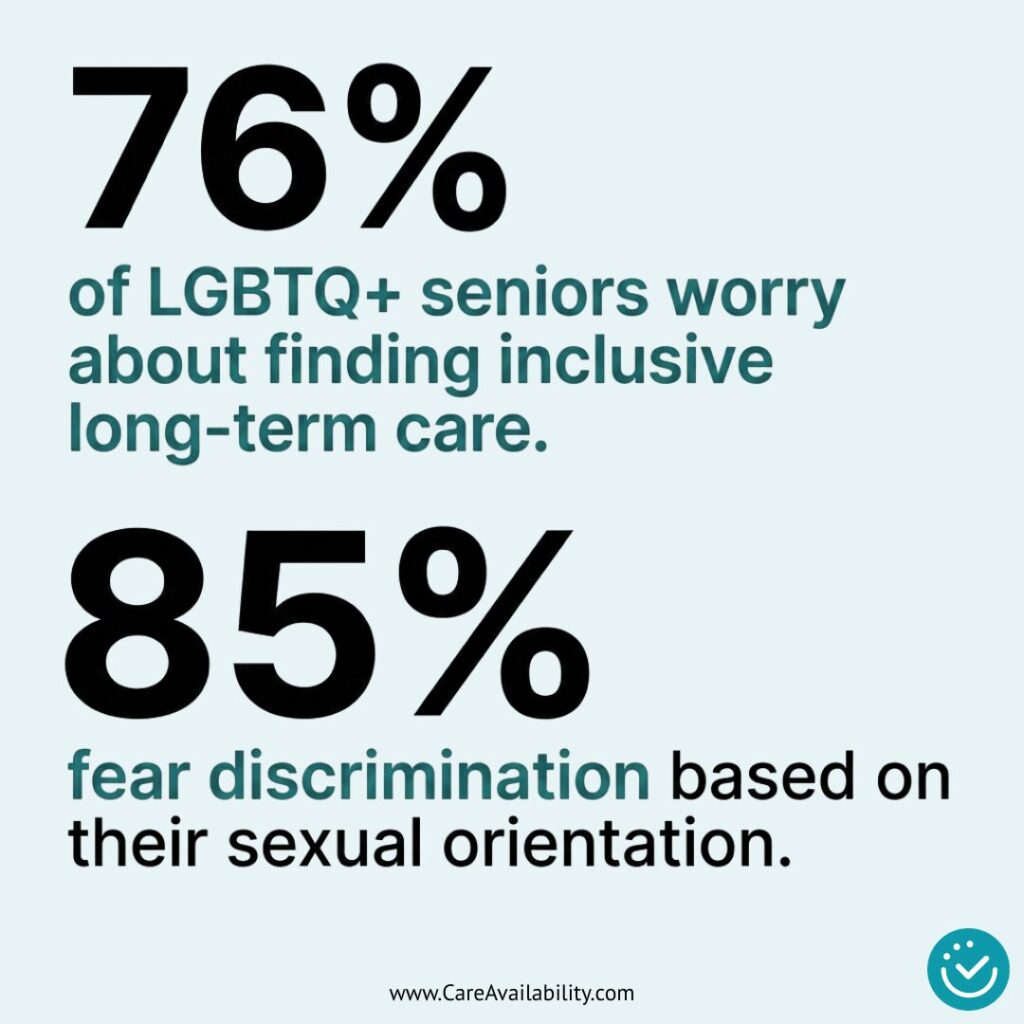
Seventy-six percent of LGBTQ+ seniors worry about finding inclusive long-term care. Eighty-five percent fear discrimination based on their sexual orientation.
That fear shows up in specific, quiet ways. A partner’s photo gets turned face-down on the nightstand. A resident stops correcting staff who assume heterosexuality. Someone skips the community social hour because the environment does not feel safe. A lifetime of identity gets tucked away to avoid conflict, judgment, or worse.
More than a third of LGBTQ+ people hide their identity [2] when they enter elder care. Not because they want to. Because they feel they have to.
Why This Generation Carries This Fear
Many LGBTQ+ seniors who came out in the 1960s or 1970s lived through an era when their identity was criminalized, pathologized, or met with violence. They had to hide to survive. They had to constantly assess whether a space was safe before revealing who they were.
Even though acceptance has improved, those experiences do not disappear [3]. The instinct to protect yourself does not go away just because laws changed.
When someone enters a care community and encounters assumptions, outdated language, or staff who seem uncomfortable, that old fear comes back. It forces them to constantly survey their environment to make sure it is safe.
The Wellness Connection: Isolation Compounds
Social isolation is already a quiet epidemic among those 50 and better. For LGBTQ+ seniors, isolation compounds.
Many LGBTQ+ seniors enter care without the traditional family support systems that other older adults rely on. Some have been estranged from biological family members who could not accept their identity. Others never had children. Some built chosen families over the years, but those relationships are not always recognized or respected in formal care settings.
When a care community asks “Who is your next of kin?” and the answer is a partner of 30 years who has no legal standing, or a close friend who gets introduced as “just a friend,” that erasure becomes one more layer of isolation.
It is not just loneliness. It is the loss of identity.
Poor social connection increases the risk of heart disease by 29%, stroke by 32%, and dementia by 50% among older adults. LGBTQ+ older adults face the same health risks as the general population, but they also encounter an additional set of risks tied to lingering social stigma and marginalization.
Half of LGBTQ+ older adults already feel socially isolated at times. That number climbs to 63 percent [4] among transgender and nonbinary adults.
When someone hides who they are to feel safe in their care community, they lose access to the very thing that protects their health: genuine connection.
July is Social Wellness Month. Social wellness is not a luxury. It is a measurable health outcome. Companion care, community activities, and environments where people feel safe being themselves are especially vital for people who live alone or withdraw.
What Families Should Look For
If you are helping a loved one find care, you can ask direct questions. You should ask direct questions.
Here is what to look for:
Non-discrimination policies that specifically include sexual orientation and gender identity. Not just a general statement. Specific language matters.
Staff training on LGBTQ+ inclusive care. Ask what training staff receive. Ask how often. Ask if it is required or optional.
A visible welcoming environment. Policies on paper mean nothing if the culture does not match. Look for signs that the community actively supports LGBTQ+ residents. Are there Pride flags or inclusive language in marketing materials? Do intake forms ask about preferred pronouns and chosen family?
SAGE accreditation or SAGECare training. SAGE [5] (Services and Advocacy for LGBTQ+ Elders) offers LGBTQ+ cultural competency training and consulting to aging service providers. Communities that have completed this training signal a real commitment to inclusive care.
The Long-Term Care Equality Index. The LEI [6] is a national benchmarking tool that evaluates senior housing communities based on four core pillars: non-discrimination and staff training, resident services and supports, employee benefits, and engagement with the LGBTQ+ community. It gives families concrete criteria to evaluate communities.
Ask these questions during tours. Do not wait. Do not assume. The right community will welcome the conversation.
What Providers Can Do
If you are a care provider, small things matter more than you think.
Using correct pronouns. Not assuming a visitor is “just a friend.” Intake forms that do not assume heterosexuality or binary gender. Staff who know how to respond when a resident shares their identity.
Ninety-nine percent of communities participating in the 2025 Long-Term Care Equality Index updated their non-discrimination policies to include sexual orientation and gender identity. That is a dramatic leap from just a few years ago, when only 18% of resident policies and 36% of employee policies included this language.
Progress is happening. The question is whether your community is part of it.
SAGE accreditation and SAGECare training provide a clear path forward. These are not theoretical programs. They are practical tools that help staff understand what inclusive care looks like in daily interactions.
The Right Resource at the Right Time Changes Everything
Finding care is hard enough without the added weight of wondering whether your loved one will be safe being themselves.
CareAvailability.com lists 115,000+ providers nationwide. Families can search, compare, and ask questions. You contact providers directly. No referral fees. No middlemen. No data sold.
Comprehensive, free, and private.
When you are searching for care, you need to see your options clearly. You need to be able to ask the questions that matter. You need to know that the community you choose will treat your loved one with dignity.
That is what we are here to help you find.
References
[1] National Center for Biotechnology Information. LGBTQ+ adults aged 50 and older population projections.
https://pmc.ncbi.nlm.nih.gov/articles/PMC11690390/
[2] The 19th News. (2021, October). LGBTQ seniors fear having to go back in closet for the care they need.
https://19thnews.org/2021/10/lgbtq-seniors-fear-having-to-go-back-in-closet-for-the-care-they-need/
[3] Salon. (2023, August 19). Older LGBTQ adults fear going back in the closet upon entering assisted living.
https://www.salon.com/2023/08/19/older-lgbtq-adults-fear-going-back-in-the-closet-upon-entering-assisted-living/
[4] Hartford Institute for Geriatric Nursing. Addressing loneliness and social isolation in LGBTQ older adults.
https://hign.org/news/hign-news/addressing-loneliness-and-social-isolation-lgbtq-older-adults-perspective
[5] SAGECare. Services and Advocacy for LGBTQ+ Elders.
https://sagecare.org/
[6] Human Rights Campaign. 2025 Long-Term Care Equality Index.
https://reports.hrc.org/2025-long-term-care-equality-index