A blood test could tell you if you’re developing Alzheimer’s disease… 20 years before symptoms appear.
That’s not a headline from a sci-fi magazine. That’s where the science is right now. And as of May 2025, it’s also FDA-cleared reality.
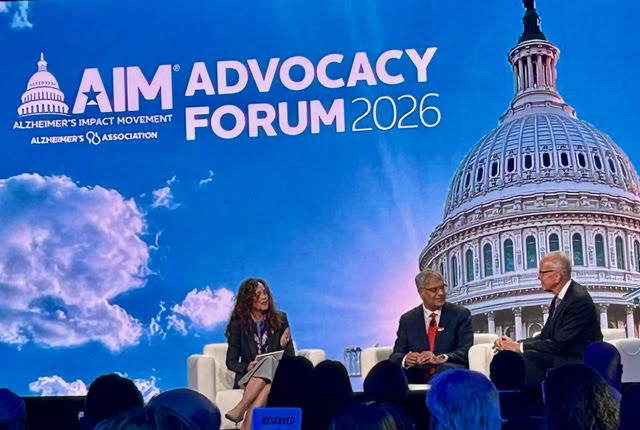
I attended the Alzheimer’s Association’s recent advocacy forum where NIH Director Dr. Jay Bhattacharya, Alzheimer’s Association President and CEO Dr. Joanne Pike, and U.S. Senator Jerry Moran (R-KS) sat together and talked frankly about where research stands, what’s working, and what’s still in the way. (Pictured above)
What I heard was both remarkable and frustrating in equal measure.
The science has genuinely outpaced the policy.
For decades, detecting the biological markers of Alzheimer’s required either a PET brain scan costing upward of $10,000 or a spinal tap. In the past year, blood tests for Alzheimer’s have improved significantly due to the incorporation of measurements of p-tau217, a specific phosphorylated form of the tau protein. A commercially available blood test for p-tau217 was found to accurately detect Alzheimer’s pathology at all stages of the disease, including before the onset of symptoms, and the results outperformed the accuracy of brain imaging.
Dr. Bhattacharya described exactly why this matters: “We’re not going to be able to do spinal taps at scale for everybody. If you have a blood draw and it’s validated, now you have the potential to scale the intervention… you essentially have the possibility of personalized treatment for Alzheimer’s disease and for senile dementia in ways that were not at all possible at scale before.”
On May 16, 2025, the FDA cleared the first blood test to aid in the diagnosis of Alzheimer’s disease. The test detects amyloid plaques, a hallmark of Alzheimer’s, through a simple blood draw. Known as the Lumipulse pTau-217/Beta Amyloid 42 Ratio test, it is now available nationwide through Labcorp and offers results comparable to existing diagnostic methods, including cerebrospinal fluid testing and PET scans, but from a simple blood draw, making it more affordable, more accessible, and less invasive.
“Today marks another important step in Alzheimer’s disease diagnosis,” said Dr. Maria C. Carrillo, Alzheimer’s Association chief science officer. “For too long Americans have struggled to get a simple and accurate diagnosis; with today’s action by the FDA we are hopeful it will be easier for more individuals to receive an accurate diagnosis earlier.”
The NIH investment behind this moment is decades deep. The NIH-funded AHEAD 3-45 Study is testing the safety and efficacy of lecanemab on individuals with amyloid in their brain but who have not yet experienced cognitive decline, with more than 20,000 individuals screened with the aid of a blood biomarker test developed with NIH investments.
The gap between diagnosis and treatment is staggering.
Dr. Pike added the context that grounds all of it: fewer than 10% of people receive an Alzheimer’s diagnosis during mild cognitive impairment, which is the phase when they’re actually eligible for treatment. As many as half of the over 7 million Americans living with Alzheimer’s are not diagnosed at all.
More than 7 million Americans are living with Alzheimer’s dementia, a number that continues to rise. In 2025 alone, health and long-term care costs associated with Alzheimer’s and other dementias were projected to total $384 billion, excluding the enormous contribution of unpaid caregivers, estimated at an additional $413.5 billion in economic value. Medicare and Medicaid are expected to shoulder nearly two-thirds of these costs, while families are projected to pay $97 billion out of pocket.
Nine in ten Americans say they would want a simple test for early detection. The demand is there. The science is there.
What’s missing is a legal pathway for Medicare to pay for it.
That’s where the ASAP Act comes in.
Senator Moran described the legislative gap plainly: “How foolish it would be if we invest all this money in research and we find things that are valued to people and their well-being, but there’s no affordable way… those results can actually be delivered to individuals.”
“CMS, if they just go through the normal process, will take years and years that we frankly don’t have. The ASAP Act is one of the most necessary pieces of legislation that I’ve seen,” said Joe Grogan, former director of the Domestic Policy Council.
Under current law, Medicare cannot cover FDA-approved screening tests unless Congress specifically authorizes it. Congress has done this for cancer. It has not yet done it for Alzheimer’s.
The Alzheimer’s Screening and Prevention (ASAP) Act would change that. Introduced with bipartisan Senate support from Senators Susan Collins (R-ME), Catherine Cortez Masto (D-NV), Shelley Moore Capito (R-WV), and Mark Warner (D-VA), the ASAP Act would create the authority for the Department of Health and Human Services to cover routine blood-based dementia screening tests, and future test methods approved by the FDA, so beneficiaries do not face needless delays or roadblocks to detection and treatment.
A March 2026 national voter survey found 88% of voters support the ASAP Act, with 72% in strong support. 75% of voters say they would be more likely to vote for a member of Congress who supports this law.
Why this matters beyond Alzheimer’s.
Dr. Bhattacharya made a point that stuck with me. He described a career in health economics watching access debates play out as zero-sum fights, and he said this: “If the price of care was half of what it is, then we wouldn’t be fighting about access.” His argument is that NIH should be investing not just in breakthrough discoveries, but in research that lowers the cost of those discoveries, so they reach everyone.
Senator Moran also chairs the Senate Down Syndrome Caucus, and he pointed out that Alzheimer’s research is producing insights that directly benefit people with Down syndrome, shingles vaccine research has turned up unexpected neurological implications, and science has a way of paying off in places you didn’t plan for. “Investment here may lead us someplace we never thought about going. But it also is cost-effective, because we find something here that matters someplace else.”
What I’m watching.
When asked what the next five years could look like if advocacy efforts succeed, Dr. Bhattacharya said he hopes we will have “a way to relatively and extensively identify what your risk profiles are, and then have a tailored intervention… and for people who are already in the grips of Alzheimer’s, a way to maybe potentially reverse it.”
Senator Moran, characteristically direct, said he hopes the Alzheimer’s Association eventually finds itself without a reason to exist. “I hope there are no members of the Alzheimer’s Association, because it’s no longer necessary.”
That’s the goal. The blood test exists. The science is ready. The ASAP Act does one thing: it gives Medicare the authority to cover blood screening tests for Alzheimer’s disease. That is it. One change. But it unlocks everything.
If you want to learn more or contact your representatives, visit alzimpact.org.
Sources
ASAP Act Fact Sheet (Alzheimer’s Association, March 2026); Interview featuring NIH Director Dr. Jay Bhattacharya, Alzheimer’s Association President and CEO Dr. Joanne Pike, and U.S. Senator Jerry Moran; Alzheimer’s Association/AIM press releases (November 19-20, 2025); NIH National Institute on Aging 2025 Dementia Research Progress Report; FDA clearance announcement, May 16, 2025; Labcorp Lumipulse launch announcement, August 2025; AIM National Voters Survey, March 2026 (Fabrizio Ward and Impact Research, n=1,000); Alzheimer’s Association Chief Science Officer statement, May 16, 2025.